Best Wall-Mount Server Rack 2026: Depth, Load and Stud Mounting Compared
When you buy through the Amazon links on this page, we may earn a commission at no extra cost to you. Learn more
Last updated October 31, 2026
The StarTech RK12WALHM is the best wall-mount server rack for most buyers: 12U, with a mounting depth adjustable up to 16 inches and a rating of 200 lb, plus lockable mesh doors and a frame that arrives fully assembled. It is an enclosed cabinet that suits switches, patch panels and other network gear in small offices, stores and server rooms, but its 16 inches of depth is the main limit for long servers.
Measure the deepest device front to back, count the U you need plus a couple spare, and find out what your wall is made of.
The best wall-mount server racks of 2026

StarTech RK12WALHM
See on Amazon
StarTech RK9WALM
See on Amazon
StarTech RACK-24U-20-WALL-OA open frame rack
See on AmazonModel comparison
| Model | Price | Rating | Weight capacity | Weight | Best for | |
|---|---|---|---|---|---|---|
| | StarTech RK12WALHM | $469.99 as of 10/31 See on Amazon | ★ 4.8 (100+ ratings) | 198 lb (90 kg) | 63.7 lb (28.9 kg) | Home or office installs wanting a finished, quiet, secure cabinet without building it first want the fully assembled frame and locking doors. |
| | StarTech RK9WALM | $307.99 as of 10/31 See on Amazon | ★ 4.7 (300+ ratings) | 198 lb | not stated | Home network builders with a fixed stack get 16-inch stud spacing, 9U of room and mesh panels that vent heat. |
| | StarTech RACK-24U-20-WALL-OA open frame rack | $317.02 as of 10/31 See on Amazon | ★ 4.7 (400+ ratings) | 200 lb | 42 lb | Network closet owners with shallow switches and patch panels get 24U of wall-mounted height without floor space. |
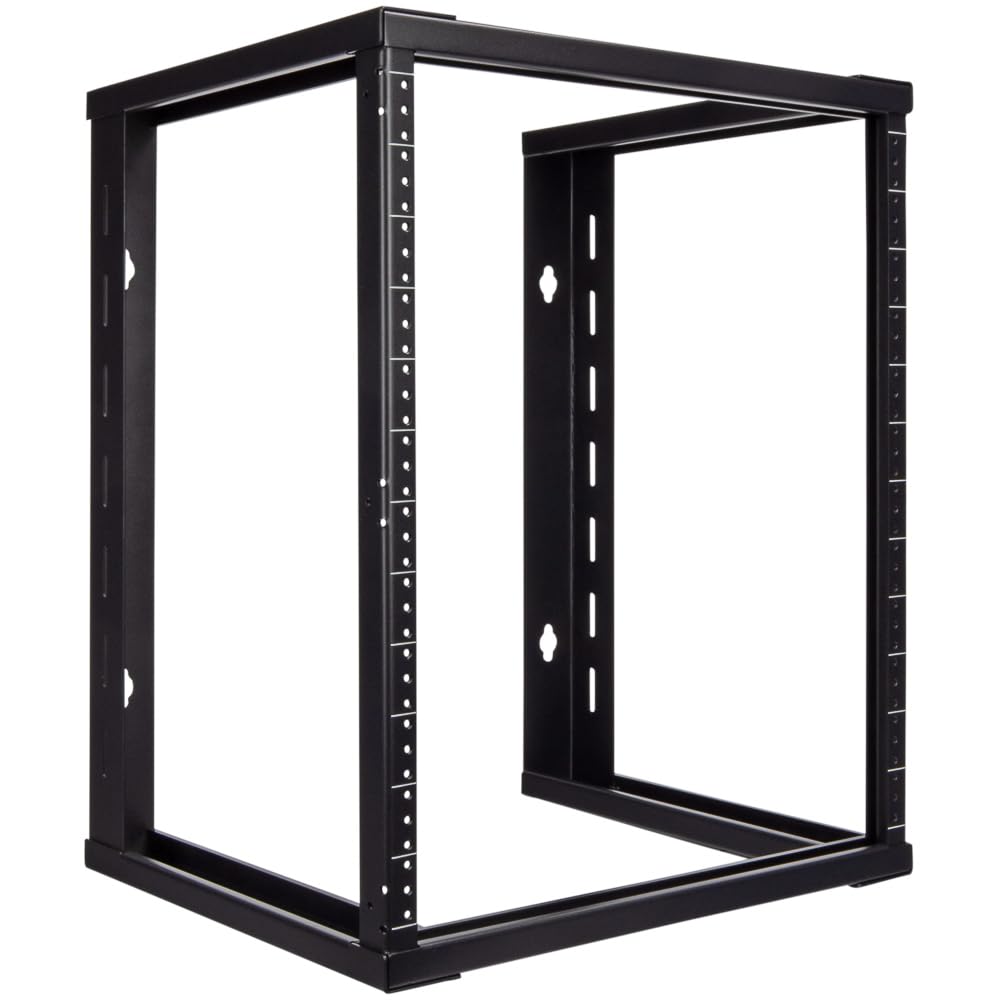 | NavePoint 12U wall mount rack | $195.99 as of 10/31 See on Amazon | ★ 4.7 (750+ ratings) | 200 lb | 21.4 lb | Budget-minded installers short on floor space want 12U on the wall without doors or locks, using the mixed threaded and square rails. |
 | Tecmojo 12U wall mount cabinet | $169.90 as of 10/31 See on Amazon | ★ 4.5 (200+ ratings) | not stated | not stated | Small offices or classrooms needing gear locked away and kept clean want the lockable glass door, side panels and included cooling fan. |
How wall mount racks differ from floor racks
A floor rack puts its own weight and the weight of everything in it straight down through feet or casters. A wall rack does the opposite: it hangs the whole load, cabinet plus gear, on a handful of fasteners, in cantilever. That single difference shapes everything else about the category.
Because the load hangs out from the wall, wall racks stay shallow so the lever arm from the wall stays short. They carry lower ratings than floor racks of the same size, and they are usually front-access only, since the back sits against the wall. Wall-hung cabinets are commonly offered up to about 18U. Past that, the sensible choices are a floor rack or a tall cabinet that hangs on the wall but stands on the floor.
A wall rack's stated capacity is a static rating measured on a rigid fixture. In a real building, the wall is usually the limiting part, not the steel.
Choosing a rack depth that fits your wall and gear
Wall racks typically run about 12 to 24 inches deep, and the depth tier decides what fits. Shallow racks take patch panels, cable managers and compact switches. Switch-depth racks take most 24-port switches. Deeper racks take long switches, short-depth UPS units and shallow servers. Full-depth servers and full-size UPS units generally push you to a floor rack.
Nominal cabinet depth is the outside measurement. Usable rail depth is the space between the front and rear rails, often several inches less. Maximum device depth is the figure the maker publishes for the deepest chassis the rack accepts, and it is the one to compare against your gear. A hinged cabinet loses more depth to the swing frame.
Measure your deepest device front to back, then add room for cable bend radius at the front for patch leads and at the rear for power cords. Compare that total to the stated maximum device depth, not to the cabinet's outside dimension. Adjustable rails let you center a device, and the adjustment increments vary from one cabinet to the next.
Making a wall mount server rack swing clear of a narrow closet
There are three access arrangements. A fixed rack is the cheapest and the most rigid, but reaching a rear port means pulling the device out. A swing-out or hinged rack lets the frame or the whole cabinet rotate away from the wall so you can get to the back without uninstalling anything. A double-section cabinet splits the difference: the front section hinges off a fixed back section that stays bolted to the wall.
The trade-off is stiffness. Hinged designs give rear access in a closet or a narrow room, but they are generally less rigid and carry a lower rating than a fixed rack of the same size. The rating that counts is the one in the open position, because that is when the load hangs furthest from the wall.
Leave clearance for the swing arc and for the door, and check that the hinge side suits the room before you drill. A cabinet that swings into a doorway is worse than one you have to unbolt.
What your wall has to carry before the first bolt goes in
Wood studs are the usual substrate in a US home or small office. Find them with a stud finder or a magnet, and note that studs are commonly 16 inches on center, though some walls are 24 and some are doubled. Rack mounting holes are usually spaced to land on two studs. Use structural screws or lag screws long enough to leave a couple of inches of thread in the wood, and pre-drill to avoid splitting. When the studs do not line up with the rack's holes, a plywood backer board spanning two or three studs solves the alignment and spreads the load at the same time.
Concrete and masonry take wedge anchors in poured concrete. Hollow block needs different fixings, since a wedge anchor has nothing solid to expand into.
Drywall alone is not a substrate for a loaded rack. Plasterboard on its own can hold a very light, shallow load at most, and never servers or a UPS. Metal studs are another case that needs specific framing or reinforcement before anything hangs on them. As a general rule, the wall structure should be able to take several times the weight of the mounted equipment.
What your wall has to carry once the rack is full
A wall rack's real capacity is a joint figure: the rack's rating and the wall's capacity, whichever is lower. The rating normally covers the combined weight of the rack and the equipment in it, so the empty cabinet's own weight comes out of your budget before you add a single device.
Cantilever behavior explains the rest. The further the center of gravity sits from the wall, the harder the top fasteners are pulled outward. A deeper cabinet at the same payload loads its fixings more than a shallow one, and pulling a server out on rails increases that pull further still. Greater vertical spacing between fasteners reduces the pull on each one, which is why a taller rack is often kinder to the wall than a short one.
Total your gear, add a margin, and keep heavy items such as a UPS in the lowest U positions and close to the wall. On a hinged rack, use the open-position rating.
Our picks by budget
The Tecmojo 12U is the budget pick because it is the only way onto this page to get an enclosure, a lock and a fan in the box at the lowest outlay, at the cost of a 110 lb rating and a 14.2-inch device limit.
The StarTech RK9WALM is the mid-range pick because the extra outlay buys a 200 lb rating, mesh airflow, 16-inch hole spacing and a cabinet that arrives assembled with a 5-year warranty.
The StarTech RK12WALHM is the premium pick because it pairs a 12 U count and the deepest gear envelope here with the full 200 lb rating, locking and shipping fully assembled out of the box.
Budget
Mid-range
High-end
Which wall-mount rack fits your setup
Matching the rack to your gear and your wall matters more than the U count on the box.
Deep gear and room to grow
You need the deepest enclosed envelope here and want the cabinet locked at every entrance. It ships assembled, so it goes on the wall the day it arrives.
Compact cabinet on a tighter wall
A 9U enclosed box with 16-inch hole spacing that lands on standard studs. Skip it if your gear is longer than 15 inches front to back.
Most U on an open frame
24U with rails you can set anywhere from 12 to 20 inches deep. Skip it if you need a door, a lock or dust protection.
Low-cost open frame for network gear
A 12U open frame 16 inches deep that keeps the load close to the wall. Skip it for long chassis or anything that needs locking away.
Cheapest enclosed cabinet with a lock
A glass door, lockable sides and a fan in the box. Skip it if any device is deeper than 14.2 inches or the load passes 110 lb.
Our verdict on the best wall-mount server racks
The StarTech RK12WALHM wins with mounting depth adjustable up to 16 inches, a 200 lb rating that includes the cabinet's own weight, and a frame that arrives assembled with locking doors at every entrance. For a smaller footprint on a tighter wall, the StarTech RK9WALM gives the same 200 lb rating in 9U with holes that land on standard studs. If you want U count and adjustable depth over an enclosure, the StarTech RACK-24U-20-WALL-OA open frame rack gives you 24U with rails you can set from 12 to 20 inches.
Detailed model analysis
Depth, load rating and how the rack meets the wall decide whether a cabinet is worth hanging, and each of these five is judged on those first.
StarTech RK12WALHM
The 12U wall-mount cabinet gives you a large enclosed space for your gear without moving to a floor rack. The mesh front door and mesh side panels let air move through passively.
The front door lifts off and goes back on either way, so the hinge side can suit the room. Doors are lockable at all entrances, which suits a closet or a shared office wall.
The frame is SPCC cold-rolled steel and the cabinet is EIA/ECA-310-E compliant, so standard 19-inch equipment lines up on the rails.
It ships fully assembled with a 1U shelf. Up to four optional fans can be added later if the cabinet runs warm. The warranty is 5 years.
It weighs about 64 lb (28.9 kg), so plan a two-person lift. The footprint is 23.6 inches wide and 25.1 inches high.
- Brand: StarTech
- Rack size: 12U
- Weight capacity: 198 lb (90 kg)
- Mounting depth: 2.4 to 16 in (6.0 to 40.6 cm)
- Dimensions: 21.7 in deep, 23.6 in wide and 25.1 in high
- Weight: 63.7 lb (28.9 kg)
StarTech RK9WALM
Made for wall mounting. The mounting holes sit 16 inches apart, so the RK9WALM lands straight on standard US stud spacing without a backer board.
At 9U, it fits a compact network stack, such as a switch, a patch panel and a small UPS.
Steel mesh covers the front door and the side panels, so heat escapes without a fan running.
It ships fully assembled, which saves an evening of bolting panels together. Rack screws, cage nuts, a shelf and a roll of hook-and-loop fastener are included.
The rails use square holes with cage nuts or tapped rails. The warranty is 5 years.
Best for a fixed set of gear. At 9U and 19.8 inches high, it suits a set that will not grow rather than a growing pile.
- Brand: StarTech
- Rack height: 9U
- Weight capacity: 198 lb
- Max mounting depth: 15 in
- Dimensions: 17.7 in deep, 23.6 in wide and 19.8 in high
- Material: Steel
StarTech RACK-24U-20-WALL-OA open frame rack
Adjustable mounting depth of 12 to 20 inches lets you set the rails to the gear instead of the other way around. This is a 2-post open frame with 24U.
Wall holes are spaced at 12 and 16 inches center to center, which covers both common stud layouts.
Capacity is 200 lb, and the open design means nothing traps heat and nothing blocks your hands. Vertical rails are 0.079 in (2.0 mm) SPCC cold-rolled steel, and the frame is EIA/ECA-310 compliant.
It ships flat-packed with brackets, M6 cage nuts and screws, assembly screws, bolts, washers and full instructions. The warranty is 5 years with free lifetime 24/5 North American tech support.
It is the tallest rack here at 46.2 inches and weighs 42 lb, so you need a clear stretch of wall and two people to hang it.
Assembly is on you, and there is no door, no lock and no dust protection.
- Brand: StarTech
- Rack height: 24U
- Weight capacity: 200 lb
- Mounting depth: 12 to 20 in adjustable
- Material: Cold rolled steel
- Weight: 42 lb
NavePoint 12U wall mount rack
Built for a wall. The NavePoint 12U is an open frame 16 inches deep with a 200 lb capacity. It holds a full network stack while keeping the load close to the wall.
Open frame airflow. The open design gives free airflow and easy reach to both sides of every device.
The frame is 0.06 inches (1.5 mm) SPCC cold-rolled steel, 20 inches wide and 24.15 inches high, finished in black.
Cable handling. Slots and tie points along the frame give patch leads and power cords somewhere to go instead of hanging loose.
It takes 19-inch rack, server and AV equipment, and ships flat-packed with all the hardware needed to assemble it.
Limits. The open frame offers no lock and no enclosure. The 16-inch depth is the main constraint for long switches.
- Brand: NavePoint
- Rack size: 12U
- Weight capacity: 200 lb
- Dimensions: 16 in deep, 20.25 in wide and 24 in high
- Weight: 21.4 lb
- Mounting: Wall mount
Tecmojo 12U wall mount cabinet
Lockable glass door and side panels keep gear behind a key in a shared space. The front door can go on either side of the cabinet, so you can set the swing to suit the room.
Inside, rails are fully adjustable, U positions are numbered, and the mounting holes are square for easy equipment fitting. Top and bottom punchout panels give cables a clean way in and out.
A cooling fan is included rather than sold separately. The cabinet is EIA/ECA-310-E compliant, takes 19-inch IT and AV equipment, and carries a warranty of 3 years.
Main limits: capacity is 110 lb, the lowest here. Deep switches, short-depth servers and rack UPS units will not fit. Assembly is required, and at 40.9 lb you will want a second pair of hands.
- Brand: Tecmojo
- Rack capacity: 12U
- Mounting type: Wall mount
- Dimensions: 17.7 in deep, 21.7 in wide and 24.3 in high
- Max equipment depth: 14.2 in
- Load capacity: 110 lb
Frequently asked questions
The wall, not the steel, is usually what limits a wall-mounted rack.
How much weight can a wall-mount server rack hold?
The racks on this page are rated from 110 lb to 200 lb, and that figure covers the cabinet plus everything you put in it. The rating is static, measured on a rigid fixture, so the wall you bolt to is usually the real limit. A shallow cabinet on two solid studs with proper screws carries far more than the same cabinet on drywall.
What if my studs don't line up with the rack's mounting holes?
Some racks give you a choice of hole spacing: the StarTech RACK-24U-20-WALL-OA open frame rack has wall holes at 12 and 16 inches center to center, and the StarTech RK9WALM has holes 16 inches apart. Where neither matches your framing, a backer board bridges the gap and spreads the load.
What size wall-mount rack do I need?
Count the U of everything going in, add two or three for cable management and growth, then check the depth against your deepest device. If your count or your depth pushes past what a wall cabinet comfortably holds, a floor rack is the better buy.
What depth do I need for a switch, a server or a UPS?
Most 24-port switches fit a switch-depth rack of up to about 16.5 inches. A compact UPS or a shallow server chassis wants 16.5 to 20.5 inches of rail space. A standard-depth server or a full-size UPS generally needs a floor rack. Compare your device's front-to-back measurement plus cable room to the rack's maximum device depth, not its outside depth.
Fixed or swing-out wall rack, which do I need?
Choose swing-out when you have to reach rear ports often. Choose fixed when the rack will rarely be opened and you want the most rigidity and the highest rating for the size. On a hinged rack, judge the load by its open-position rating.
When should I stop and buy a floor rack instead?
When your U count passes about 18, when your deepest device needs more than roughly 20 inches of rail space, or when the loaded weight climbs past what your wall can safely take. At that point a floor rack or a wall-hung cabinet that stands on the floor is the safer choice.