
Best Open-Frame Rack 2026: Airflow and Easy Cable Access Without a Cabinet
When you buy through the Amazon links on this page, we may earn a commission at no extra cost to you. Learn more
Last updated October 31, 2026
The StarTech 4POSTRACK12U is the best open-frame rack for most buyers because its depth adjusts from 22 to 40 inches, it has four posts to support servers, and it includes casters, leveling feet, and a bolt-down plate. An open-frame rack is vertical mounting rails and a supporting frame with no sides, doors, or top, so air moves freely and you can reach any port or cable without opening anything. The trade-offs are dust, noise, and no physical security.
The best open-frame racks for 2026

StarTech 4POSTRACK12U
See on Amazon
StarTech RK8OD
See on Amazon
Echogear EGAV-PROF20 open frame rack
See on AmazonModel comparison
| Model | Price | Rating | Weight capacity | Material | Rack size | Best for | |
|---|---|---|---|---|---|---|---|
| | StarTech 4POSTRACK12U | $249.99 as of 10/31 See on Amazon | ★ 4.7 (2,000+ ratings) | 1200 lb | Cold-rolled steel | not stated | Homelab builders mounting a full-size server plus UPS on the floor want the adjustable 22 to 40 in depth and 1200 lb capacity. |
| | StarTech RK8OD | $57.36 as of 10/31 See on Amazon | ★ 4.7 (1,300+ ratings) | 110.2 lb | Alloy steel | 8U | Home office users who cannot drill into a wall get an 8U tabletop frame with marked U heights and 110.2 lb of capacity. |
| | Echogear EGAV-PROF20 open frame rack | $229.99 as of 10/31 See on Amazon | ★ 4.7 (1,200+ ratings) | not stated | Alloy steel | 20U | Businesses expecting to add devices and stack a second rack later get a 600 lb floor rating and 40U stacking. |
 | NavePoint 18U swing gate rack | $132.51 as of 10/31 See on Amazon | ★ 4.4 (1,000+ ratings) | 110 lb | not stated | not stated | Admins fitting out a cramped data closet get a wall-mounted 18U frame whose swing gate opens rear access. |
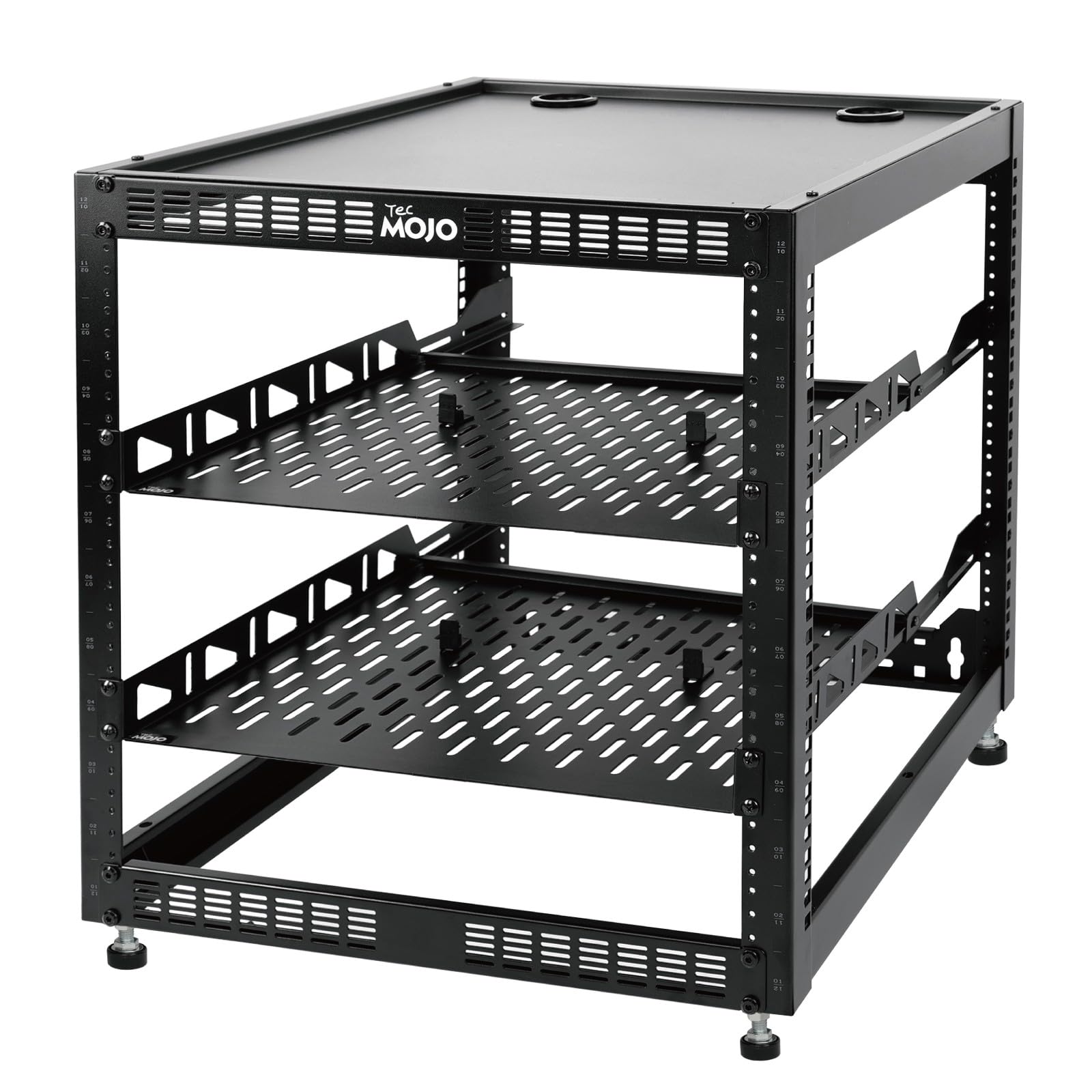 | Tecmojo 12U open frame rack | $89.90 as of 10/31 See on Amazon | ★ 4.4 (450+ ratings) | not stated | not stated | 12U | AV or IT setups that would otherwise buy shelves separately want the two ventilated shelves included and the floor or wall choice. |
How open frame racks differ from cabinets for airflow and access
An open frame has no enclosure to trap heat, so hot exhaust leaves the frame instead of pooling inside it. That is the real advantage: the frame does not add cooling, it removes a barrier. The counterintuitive part is that an open frame with empty U left uncovered can run hotter than a well-managed cabinet, because server exhaust recirculates straight back into the intakes above and below it. The fix is to blank every unused U (count = total U minus installed U) and orient the frame so intakes face the cool side of the room. A top-mounted exhaust fan tray is only needed when room cooling is inadequate.
Access is the second gain. No door means no swing clearance, no latch, and no key, so you can pull a cable or swap a drive from the front or the back without opening anything. That matters most during build-out and during any change, which is why open frames suit labs and closets where hardware changes often.
Openness costs you dust, noise, and security. Dust settles on every upward-facing surface and every fan intake, a real issue in garages, workshops, and unfinished basements, where dust insulates heatsinks and clogs fans. Noise has no barrier between the gear and the room, though a well-ventilated open frame often lets fans run slower than a poorly ventilated cabinet, so the practical difference is smaller than expected. Security is binary: there are no locks, so anyone in the room can unplug anything. Open frames belong in a room you control.
The calculus flips in shared space, a living area, with pets, or when you need to lock gear away. A hybrid setup, a small open frame or wall-mount frame for network gear plus an enclosed cabinet for servers, is often better than one compromised rack.
Choosing an open frame rack by frame style and rail type
Two-post frames have front rails only, no rear support, and no depth adjustment, and they are usually lighter and cheaper. They are fine for patch panels, switches, routers, 1U appliances, and AV gear. The limit is not the load rating, since two-post frames are rated in the high hundreds to 1,500 lb, but the lack of rear support and the fixed depth: gear deeper than roughly 20 inches has nothing holding its back end.
Four-post frames have front and rear rails with adjustable depth, are made of steel, and are rated from about 1,000 lb to 3,500 lb. They are required for any rackmount server, storage array, or rack UPS. The decision rule is simple: if even one rackmount server is on the list, buy four-post, because the price gap is small and a four-post frame does everything a two-post does.
Adjustable depth is the range that matters, measured as the distance between front and rear rails. Measure the deepest device from its front face to the rearmost connector and add about 4 inches for cable bend radius; that is your minimum usable depth. Frames with a wide adjustment range cover future gear; fixed-depth frames do not.
Rail and thread type decide what fits. Square holes take cage nuts and are the current standard: replaceable, and what most tool-less rail kits expect. Threaded round holes (10-32, 12-24, M6) take a screw directly but strip with repeated changes. Round unthreaded holes take clip nuts. The thread must match your cage nuts and screws, and snap-in accessories are made for one hole type only, so a mismatch means returns.
EIA/ECA-310-E, with IEC 60297 and DIN 41494 as the international equivalents, is the 19-inch standard. Compliance is voluntary but effectively universal; a frame that states it is stating that standard 19-inch gear will line up. For height, pick from standard sizes and round up after adding roughly 20% headroom for cable managers, shelves, and growth. Rack height is not simply U times 1.75 inches, because there is non-usable space at the top and bottom.
How to build your open frame rack and hold it steady once it is standing
Most frames ship flat-packed. Assemble the two side frames first, then join them with the cross members, then fit the rails, and leave every bolt finger-tight until the whole frame is together. Before tightening, measure both diagonals of the assembled frame; if they differ, the frame is racked and the rails will not be parallel. Adjust until the diagonals match, then tighten in a cross pattern. A frame that is out of square will fight every piece of equipment you slide in.
Assemble and position the empty frame where it will live. A loaded frame is very hard to move, and a tall frame is hard to walk through a doorway once built.
Anchoring depends on weight and mounting. A loaded frame over roughly 150 lb should stand on the floor, not hang on a wall. Wall-mounted frames must be fixed into at least two studs with the manufacturer's hardware, not drywall anchors. Floor-standing frames should be secured with the base plate or with leveling feet firmly loaded, especially tall frames, because a top-heavy frame can tip if something pulls on it or someone leans on it.
Plan at least 3 ft (0.9 m) of aisle in front and behind for access and cable work, and check ceiling height before choosing a tall frame: a 42U frame is around 78 inches tall, a 45U around 84 inches, and casters add a couple of inches. Put the heaviest items at the bottom. A shelf fitted low adds rigidity to the frame and lowers the center of gravity.
Our picks by budget
The StarTech RK8OD is our budget pick because it is the entry point: a compact two-post frame for switches, mini PCs, and AV gear, with a lifetime warranty and M5 cage nuts and screws included.
The Echogear EGAV-PROF20 is our mid-range pick because it turns the frame into a real installation: steel construction, 600 lb on the floor or 200 lb on the wall, leveling feet, vented shelves, and assembly quoted at under 20 minutes.
The StarTech 4POSTRACK12U is our premium pick because it is built to a standard and specified in detail: adjustable depth from 22 to 40 inches, 1,200 lb stationary, EIA/ECA-310-E, IEC 60297, and DIN 41494 compliance, and casters, feet, and a bolt-down plate all included.
Budget
Mid-range
High-end
Which open frame rack for which buyer profile
The right frame depends on what you are mounting and where it will live, not on the number of U alone.
Desk or shelf, small and shallow gear
The StarTech RK8OD puts switches, mini PCs, AV boxes, and a home-lab starter in order on a desk or shelf. It is not for servers.
Full network or AV install in a closet
The Echogear EGAV-PROF20 stands or hangs and arrives with vented shelves, so it is ready on day one. Best when nothing on the list is deeper than 19 inches and the frame may need to hang on a wall.
Rackmount servers or gear that will change
The StarTech 4POSTRACK12U has adjustable depth and four-post support, and its included casters, feet, and bolt-down plate let it be installed any of the three ways without buying extras.
Wall-mounted in a tight space, light load
The NavePoint 18U swing gate rack hangs where floor space is short and gives reach without a door. Its 110 lb capacity is the constraint to check first.
Budget-conscious AV or multi-device setup
The Tecmojo 12U open frame rack comes with shelves and cable straps in the box, and it can stand or hang. It suits classrooms, retail, and small offices where the load is modest and the frame may be stacked or expanded later.
Our verdict on the best open-frame racks for 2026
The StarTech 4POSTRACK12U wins because adjustable depth, four-post support, a 1,200 lb stationary rating, and casters, leveling feet, and a bolt-down plate in one box cover the widest range of real setups. It is the frame that does not need replacing when the gear changes. The Echogear EGAV-PROF20 is the value pick for the buyer who needs shelves and a wall option and has no deep gear, and the StarTech RK8OD is the small-setup pick. The one-line rule: if there is a server on the list, four-post; if there is not, match the frame to the depth and the mounting surface.
Detailed model analysis
An open frame earns its place by what it does not enclose: the depth range, the rail type, and the mounting options decide whether it fits your gear and your room.
StarTech 4POSTRACK12U
The StarTech 4POSTRACK12U is an open-frame floor rack with four posts and no doors, side panels, or lock. Air moves through, and you reach any cable from the front or back.
The mounting depth adjusts from 22 to 40 in, so a short switch and a long server can share the rack. It holds 12U of 19 in equipment, with depth and rack unit markings printed on the frame.
Its static load rating is 1200 lb (544 kg), well above the Echogear EGAV-PROF20 at 600 lb. That applies to a stationary rack, and the load on casters is not stated.
Four casters, four leveling feet, and a pre-drilled base for bolting to the floor come in the box, so you choose rolling, level, or fixed. You also get 24 M6 cage nuts, four cable management hooks, and four grounding wires.
It weighs about 50.1 lb (22.74 kg), ships flat-pack, and needs assembly. The open frame gives no security at the rack level. The warranty runs 2 years, with free lifetime 24/5 technical help.
It suits anyone racking full-size servers on the floor who wants adjustable depth.
- Brand: StarTech
- Rack height: 12U
- Adjustable mounting depth: 22 to 40 in
- Weight capacity: 1200 lb
- Weight: 50.1 lb (22.74 kg)
- Material: Cold-rolled steel
StarTech RK8OD
The StarTech RK8OD is a small open frame with two posts that holds 8U of 19 in equipment. You reach every port from the front and back.
It is the only tabletop rack among the picks, so it fits a workbench or a small home office without a wiring closet. You can also set it on a desk, table, or floor.
It weighs about 4.8 lb (2.16 kg), has marked U heights for lining up gear, and ships as a compact flat pack with M5 cage nuts and screws.
The main limit is load. It is rated for 110.2 lb (50 kg), so a heavy server is a poor fit. It has two posts, not four like the StarTech 4POSTRACK12U.
The warranty is lifetime, the longest stated of the five, with free lifetime 24/5 technical help.
It suits home office users who cannot drill into a wall and want a light desktop frame for 19 in networking, AV, or media gear.
- Brand: StarTech
- Rack size: 8U
- Weight capacity: 110.2 lb
- Rack type: 2-post open frame
- Equipment width: 19 in
- Material: Alloy steel
Echogear EGAV-PROF20 open frame rack
The Echogear EGAV-PROF20 is an open frame rack with 20U of mounting space. The open frame moves air around your gear and keeps cables within reach.
Two vented shelves come in the box: a 1U shelf 15.12 in deep and a 2U shelf 18 in deep. Four leveling feet are included, or you can hang the rack on a wall.
On the floor it holds 600 lb. On the wall it holds 200 lb. That floor rating sits below the StarTech 4POSTRACK12U at 1200 lb.
The rack measures 20.39 in deep and 20.42 in wide. Equipment can be up to 19 in deep, so deeper servers will not fit. Server rails are not included, so bring the rails made for your server brand.
It stacks up to 40U and assembles in under 20 minutes with the included hardware and a screwdriver. Casters, swing-out mounting arms, and extra shelves are sold separately.
It suits businesses that expect to add devices and want the choice of wall or floor.
- Brand: Echogear
- Rack size: 20U
- Dimensions: 20.39 in deep, 20.42 in wide and 35 in high
- Material: Alloy steel
- Included shelves: 2 vented shelves
- Color: Black
NavePoint 18U swing gate rack
The NavePoint 18U is a wall-mounted open frame with a dual-hinged front gate. The gate opens 180 degrees from either left or right, so you can reach rear panels and cables for servicing.
It is the only rack here with a swing gate. Spring-loaded pivot pins let you hinge it on either side, and you can remove the gate during assembly or maintenance and reattach it later.
The gate has threaded holes on one side and universal square rack holes on the other, which suits a wide range of 19 in equipment. The steel frame has a black powder coating and weighs 35.1 lb.
The open design promotes passive cooling for networking and AV gear. The big limit is load: it carries a maximum of 110 lb, while the Tecmojo 12U open frame rack handles 130 lb on a wall.
It mounts only on a wall, with no floor option. It ships flat-packed with the hardware needed to assemble it, so plan on putting it together.
It suits admins fitting out a cramped data closet who need rear access through a swinging gate and will keep the load under 110 lb.
- Brand: NavePoint
- Rack height: 18U
- Depth: 18 in
- Dimensions: 18 in deep, 20.8 in wide and 36.5 in high
- Weight capacity: 110 lb
- Weight: 35.1 lb
Tecmojo 12U open frame rack
The Tecmojo 12U open frame rack comes with two ventilated 1U shelves and mounts on a wall or on the floor. Its open layout keeps air moving and gives you easy access to ports and cables.
The cold rolled steel frame weighs 28.6 lb. It holds 260 lb on the ground and 130 lb on a wall. Back supports raise the load limit.
Four anti-slip shelf stops hold devices in place, and four velcro straps come in the box. A top panel adds space. Other compatible racks can stack with it for expansion.
Setup comes with a manual, a mounting hole drilling template, and an online assembly video. The manufacturer covers it with a 3 years warranty.
The main limit is the load on a wall. Mounting there cuts the rating from 260 lb to 130 lb, so plan the load before you drill. It is also an open frame, not an enclosed cabinet.
It suits AV or IT setups that would otherwise buy shelves separately and want the choice of floor or wall mounting, with both shelves in the box.
- Brand: Tecmojo
- Rack size: 12U
- Mounting: Wall or floor standing
- Wall-mounted load capacity: 130 lb
- Floor-mounted load capacity: 260 lb
- Dimensions: 20.15 in deep, 20.47 in wide and 21.02 in high
Frequently asked questions
Airflow, depth, and load ratings are the questions that decide an open-frame purchase.
Is an open frame rack really cooler than a cabinet?
It removes the enclosure that traps heat, but only if empty U are blanked and the frame faces the cool side of the room. Otherwise exhaust recirculates into the intakes and the open frame can run hotter than a managed cabinet.
How do I work out the depth I need?
Add about 4 inches to the deepest device's front-to-rear measurement for cable bend radius. The total is the minimum usable depth the frame's adjustable range must cover, so a frame whose range falls short of it will not hold that device.
Should I build the frame where it will stand, or assemble it first and move it into place?
Build it where it will live. An empty frame is far easier to position than a loaded one, and a tall frame becomes awkward to carry through a doorway once it is fully assembled. Get the frame standing in its final spot before any equipment goes on the rails.
Can I add side panels or a door later?
Only if the frame is designed for it. An open frame is a frame, not a cabinet with the panels left off. If you may need enclosure later, buy an enclosed cabinet now.
What should I do with the unused rack units in an open frame?
Fill every empty U with a blanking panel. The count you need is your total U minus the U your installed gear occupies. Without them, hot exhaust from one server can be drawn straight back into the intakes of the equipment above and below it, so the frame ends up running hotter than a well-managed cabinet.
How much floor space does a frame need?
Start with the frame's own footprint, then allow working room on both the front and rear sides, and check ceiling height: around 78 inches for a 42U frame, around 84 inches for a 45U, plus a couple of inches if casters are fitted.