
Best Server Rack on Wheels 2026: Casters, Load Capacity and Moving a Loaded Rack
When you buy through the Amazon links on this page, we may earn a commission at no extra cost to you. Learn more
Last updated October 31, 2026
The best server rack on wheels for most home labs and small offices is the StarTech 4POSTRACK12U: a 12U open frame with mounting depth that adjusts from 22 to 40 inches, a 1,200 lb stationary rating, and casters, leveling feet and a floor base plate included, so it can roll, sit on feet, or bolt to the floor.
What decides whether a wheeled rack is safe is not the number on the box. It is the capacity of the caster setup you actually use, the wheel type, and whether the rack is parked on its feet once it stops moving.
The best server racks on wheels for 2026

StarTech 4POSTRACK12U
See on Amazon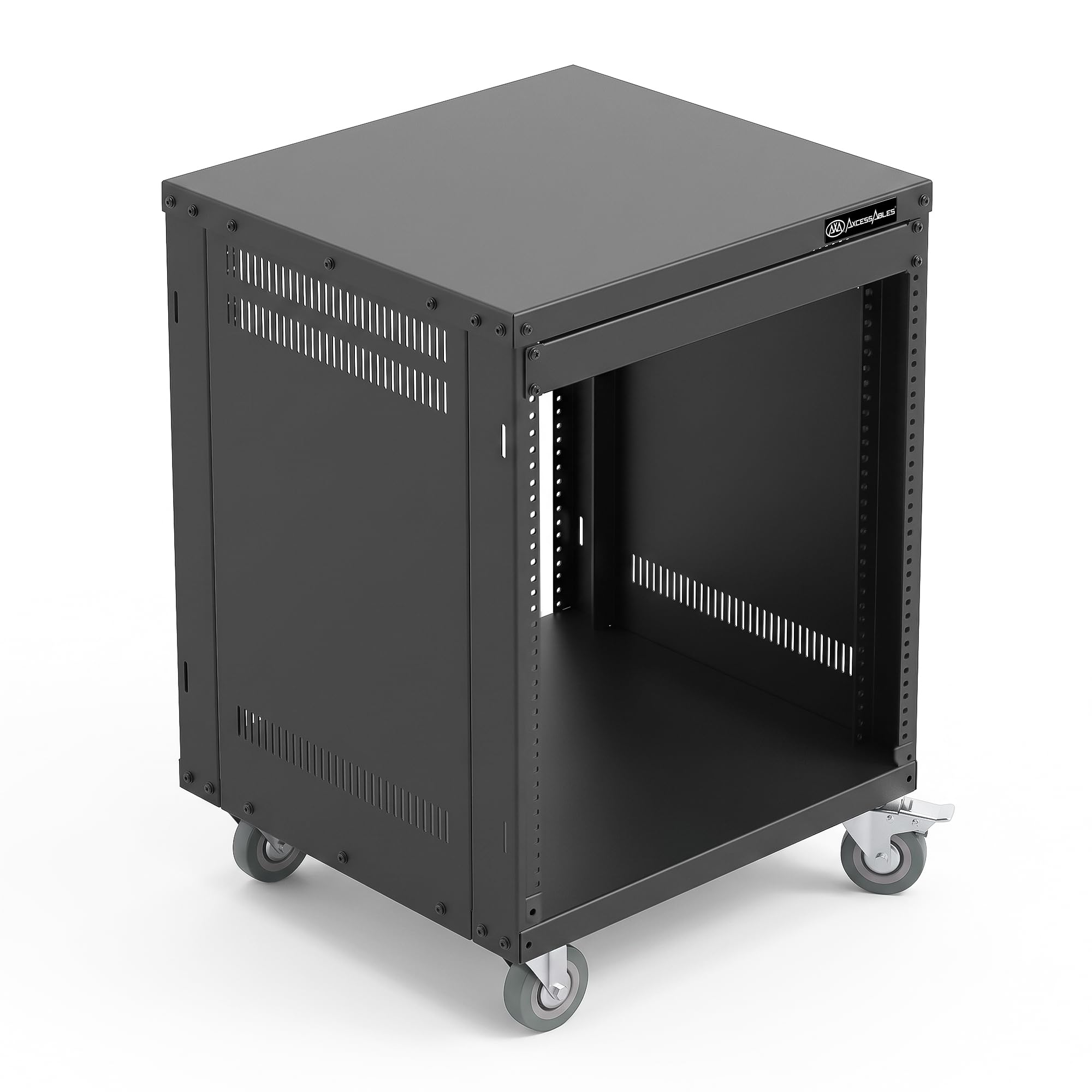
AXA AxcessAbles RK12U network rack
See on Amazon
Vivo CART-SR25U server rack cart
See on AmazonModel comparison
| Model | Price | Rating | Weight | Material | Rack height | Best for | |
|---|---|---|---|---|---|---|---|
| | StarTech 4POSTRACK12U | $249.99 as of 10/31 See on Amazon | ★ 4.7 (2,000+ ratings) | 50.1 lb (22.74 kg) | Cold-rolled steel | 12U | Homelab builders mounting a full-size server plus UPS on the floor want the adjustable 22 to 40 in depth and 1200 lb capacity. |
| | AXA AxcessAbles RK12U network rack | $159.99 as of 10/31 See on Amazon | ★ 4.5 (550+ ratings) | not stated | Alloy steel | 12U | Budget home lab builders with shallow gear get pre-installed 3 in casters and a compact 18 in deep frame. |
| | Vivo CART-SR25U server rack cart | $219.99 as of 10/31 See on Amazon | ★ 4.7 (100+ ratings) | 58.2 lb | not stated | not stated | Home labs or small offices needing more U and depth get 25U, 22 to 40 in adjustable depth and optional leveling feet. |
 | StarTech 2POSTRACK42 | $252.99 as of 10/31 See on Amazon | ★ 4.6 (60+ ratings) | 52.0 lb (23.59 kg) | Alloy steel | not stated | Tight-room installs of switches and patch panels get a tall 42U dual-post frame on four swiveling casters. |
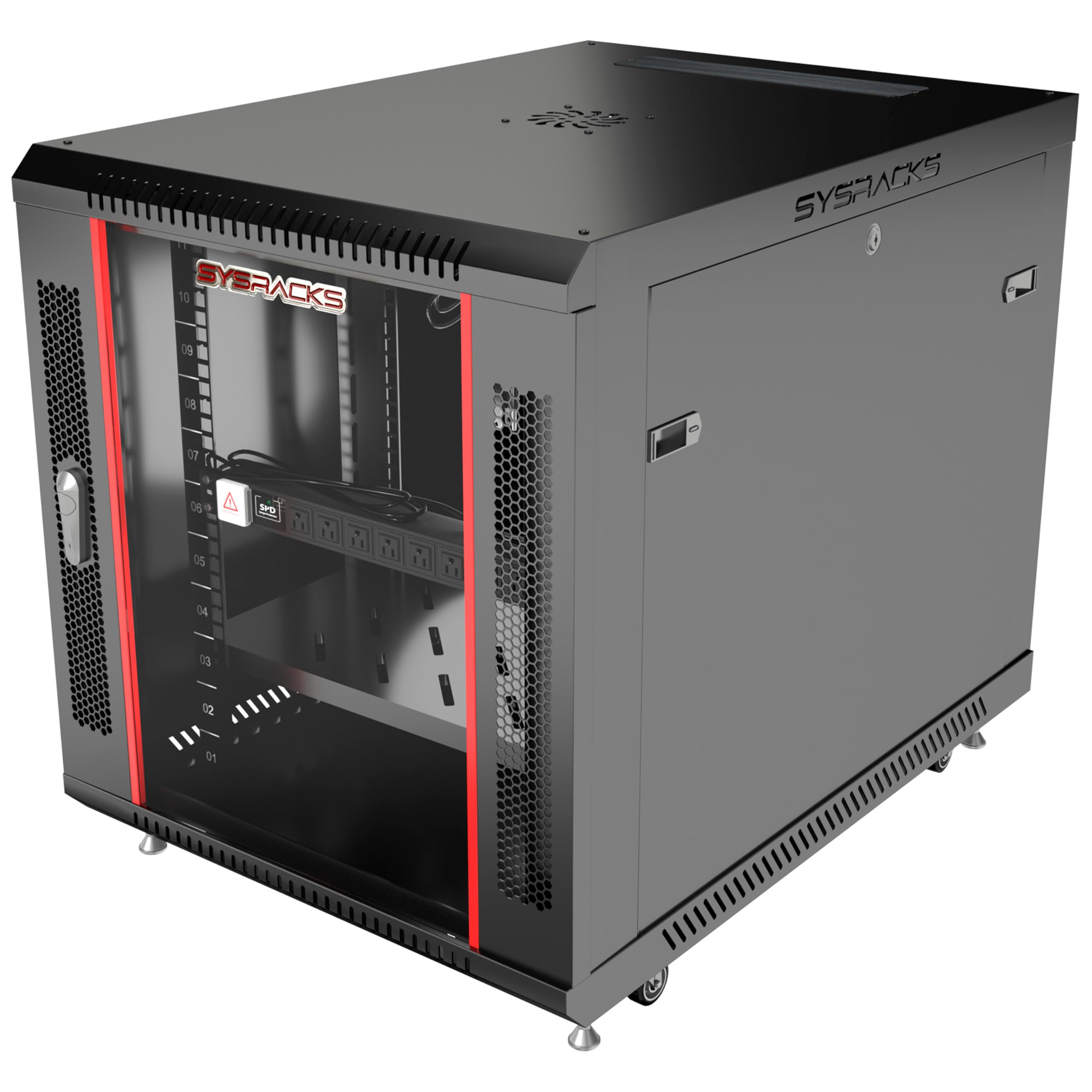 | Sysracks PR-12 server rack cabinet | $559.87 as of 10/31 See on Amazon | ★ 4.4 (50+ ratings) | 55 lb | Steel | 12U | Small businesses wanting gear behind a lockable door get a 12U cabinet with PDU, fan and locking casters included. |
What a server rack on wheels changes about the load it can carry
The capacity printed on a rack is usually the stationary figure, measured with the frame resting on leveling feet or a base plate. Put the same rack on casters and the load path changes: the weight now travels through four small contact patches, through the caster plate and its fasteners, into the base of the frame, and then into the floor. The casters, not the frame, become the limiting part.
That is why a caster-rated capacity sits below the static capacity of the same cabinet. A 12U open frame rated 1,200 lb stationary, with casters, leveling feet and a base plate included, carries that 1,200 lb on its feet or base plate; the caster setup is the configuration to check before you load it. A 42U frame that ships with four swiveling casters on heavy-gauge steel has a frame rating, and the casters are the part that actually carries it.
How the weight really spreads across four wheels
On four casters the weight is not divided by four in practice. Floors are never perfectly flat, and in a turn or over a threshold the load shifts onto two or three wheels. The working rule is to size for total loaded weight divided by 3, then add a margin: around 20% for a rack that is set down gently, more where it may be dropped or rolled over a lip.
The floor is part of the system
A raised access floor, a suspended timber floor and a carpeted slab each behave differently under a few hundred pounds on four small wheels. Check the floor's own load limit before you fill the rack, especially on an upper story or over a crawl space.
The frame flexes differently too
A 0.06 in (1.5 mm) steel frame, a cold-rolled steel 4-post frame and a steel cabinet each flex differently when rolled loaded. A 4-post frame with four vertical rails spreads the load across more of the base than a 2-post frame, which matters most when the rack is tall and the gear is heavy.
Caster types and what each one does on a data room floor
Four behaviors cover almost every caster on a rack. Rigid (fixed) casters track straight and carry load well but cannot steer. Swivel casters steer but can shimmy. Locking casters stop the wheel from rolling. Braked or total-lock casters lock both the wheel and the swivel, so the rack can neither roll nor pivot. A rack with wheel locks only can still rotate in place under vibration.
The standard arrangement
Two swivel casters at the front and two rigid at the rear is what makes a tall rack track predictably when pushed from the front. Some racks ship with four swiveling casters instead, which steers more freely but needs the brakes set before anyone leans on the frame. A 12U frame with 3-inch industrial-grade casters already installed, two of which lock, is a common budget setup; a cabinet with locking casters on all four corners is the usual enclosed-cabinet arrangement.
Wheel size and material
Larger wheels roll over thresholds and carpet edges far more easily than small hard ones. Polyurethane tread is the default for tile, epoxy and raised access floors: it rolls quietly and does not mark. Hard rubber is quieter still but needs noticeably more push force and can flat-spot under a static load. Steel wheels carry the most but damage flooring. Three inches is the practical minimum for a loaded rack.
Brake placement
Two total-lock casters on diagonal corners are what actually stop a parked rack from walking. Wheel-only brakes on the front pair hold it from rolling but not from pivoting, which is fine against a wall and less so in the open.
How casters attach
Plate-mount casters bolted through a reinforced base pad are the norm on loaded racks. The bolt pattern is not universal, so a retrofit kit has to match the hole spacing on the base. A rack bought with casters from the start avoids the problem entirely.
Leveling feet versus casters and when to use both
Casters are for moving and feet are for standing. A rack that lives on its casters permanently puts a static point load on four small wheels, which flat-spots the tread, lets the brakes creep, and indents soft flooring. The frame also stays slightly less rigid than it would on feet.
The correct parked state
Roll the rack into position, lock the casters, then lower the leveling feet until the casters carry no weight, and check that the frame is plumb. The feet take the load; the casters are there for the next move. A rack that includes casters, leveling feet and a base plate can be mobile now and fixed later without buying anything else.
Dropping the feet without shifting the load
Lower them a turn at a time, alternating corners, and watch the frame for any lean. Never jack one corner up hard while the other three are still on casters: the frame twists, and a loaded rack can shift sideways.
What skipping it costs
Vibration from fans and drives travels into the wheels and the floor. The rack can drift or pivot on wheel-only brakes. And a top-heavy frame on casters is easier to tip than the same frame on feet. A caster-only rack has nothing to take the weight off the wheels, so it is the one to think about if the rack will ever be parked long-term.
Moving a loaded rack safely
A populated rack can be rolled within its caster rating, and the method matters more than the muscle. Work through these steps in order.
- Lower the center of gravity first. Heaviest equipment at the bottom (UPS, servers, power amps), light patch panels and switches at the top. A tall rack is top-heavy by nature, and a 25U frame at 51 inches or a full 42U frame needs the weight kept low.
- Clear and walk the route before loading. Doorway widths, turns, thresholds, ramps, the elevator sill, cable covers on the floor.
- Use two people, one at each side, pushing from the frame. Never one person pulling from the front on a slope. A spotter walks ahead.
- Cross thresholds and ramps slowly and squarely. Hit them at an angle and the load shifts onto two wheels; a small lip multiplies the force through the casters.
- Control speed. Walking pace, no shoving, stop before changing direction.
- Park and lock. Casters locked, feet down, cables re-dressed.
Cables during the move
Leave service loops long enough for the rack's travel, or disconnect before the move. Cables pulled taut will either unseat a connector or drag equipment off a shelf.
When not to move it loaded
Unload first if the rack is near its caster limit, if the route has stairs, or if the frame is a tall 2-post design. An open-depth dual-post frame is the least forgiving to roll with gear in it.
Floor protection, thresholds and the route you need to plan
Measure before you buy, not after the rack is assembled. The numbers that stop a move are the narrowest doorway on the route, the hallway turn, the stair landing, the elevator door and its weight limit. A tall assembled rack may not rotate through a standard interior door: a 12U rack at 26 to 27.5 inches high clears most routes, a 25U at 51 inches or a 42U does not.
Depth is part of the route problem
Set the mounting depth to the deepest chassis plus rear clearance for cables and airflow, then check that the resulting footprint still fits the room and the route. Adjustable depth from 22 to 40 inches gives you that room to maneuver; a fixed 18-inch depth is easier to place but limits what goes inside.
Floor load
A loaded rack concentrates its weight on four small contact patches. Check the floor's rated load, especially on upper floors, raised access floors and suspended timber.
Protecting the floor and the frame
Polyurethane casters on tile and epoxy. A sheet of hardboard or a mat over thresholds and carpet edges. Corner protection on door frames, because a steel corner and a painted jamb do not negotiate.
Ramps and grades
Keep grades shallow, approach square-on, and never let the rack get ahead of the pusher on a downslope.
Securing a wheeled rack so it stays put
Locking the casters and dropping the feet is the baseline parked state. Everything else on this list is what keeps a mobile rack where you left it when someone bumps it, when the floor moves, or when a fan spins up.
Anchor or bracket where it can be knocked
A base plate that secures the rack to the floor is the right choice for a rack that is mobile during setup and fixed afterward. A caster-only rack relies on its locking casters alone, which is fine in a closed closet and less so in a busy room.
Anti-tip habits
Keep heavy gear low. Do not stack a tall rack with light gear at the bottom and heavy at the top. Consider a wall or floor bracket for a 25U or 42U frame in a room where people walk past it.
Cable slack
A rack that can be repositioned needs service loops at the wall, strain relief where the cables enter the rack, and routing that cannot be pulled when the rack rolls. Label both ends so a move does not turn into a re-cable.
Vibration
Total-lock brakes on diagonal corners plus the feet down is what stops fan vibration from walking the rack across a smooth floor.
Our picks by budget
The Axa Axcessables RK12U is the budget pick because the 3-inch casters are already installed, two of them locking, so a compact 12U frame rolls the day it arrives with no kit to match or drill.
The StarTech 4POSTRACK12U is the mid-range pick because the extra money buys adjustable depth from 22 to 40 inches plus casters, leveling feet and a base plate bolted to the floor in one box.
The Sysracks PR-12 is the premium pick because the cabinet arrives closed and lockable with a PDU, a cooling fan, a shelf and locking casters already inside, so power and airflow are part of the purchase rather than a second order.
Budget
Mid-range
High-end
Which server rack on wheels fits your setup
The right wheeled rack depends less on budget than on how deep your gear is and whether the rack will ever be fixed in place.
Home lab on a budget
Shallow gear, a small room, and a rack that has to roll out for rear access. The casters are already fitted, and the screws and blank panel come in the box.
Full-depth server or UPS
You want to set the mounting depth to your chassis and keep the option of fixing the rack to the floor later. Adjustable depth plus casters, feet and a base plate cover both.
Closed cabinet for an office
Equipment behind a lockable door, with power and cooling already inside instead of bought separately.
More U and more depth
A heavier frame with four vertical rails, adjustable depth in 1-inch steps, and the choice between casters and leveling feet.
Tall and narrow install
Patch panels and switches in a tight room where floor space is short and deep chassis are not part of the plan.
Our verdict on the best server rack on wheels
The StarTech 4POSTRACK12U is the best all-round pick for most readers: adjustable depth from 22 to 40 inches, a 1,200 lb stationary rating, and casters, leveling feet and a floor base plate all in the box, so the rack can be mobile now and fixed later. The Axa Axcessables RK12U is the budget choice for shallow gear, the Sysracks PR-12 is the enclosed pick with power and cooling inside, the Vivo CART-SR25U covers anyone who needs more U and more depth, and the StarTech 2POSTRACK42 handles a tall, narrow install.
The capacity figure to trust is the one for the configuration you will actually use, on casters rather than on feet. And a wheeled rack should be parked on its feet: lock the casters, lower the leveling feet until the wheels carry no weight, and check the frame is plumb.
Detailed model analysis
A rack that rolls is only as good as the casters under it and the depth it can be set to, so each pick is judged first on how it moves and what it holds when loaded.
StarTech 4POSTRACK12U
The StarTech 4POSTRACK12U is the rack to pick when your gear is deep and heavy. Its four posts adjust to mount equipment from 22 to 40 in deep, so a full-size server and your switches can share one frame.
It holds 1200 lb when stationary. That rating covers a parked rack, so move it with little on it and load it once it is in place.
It comes with four casters and four leveling feet, and the base is pre-drilled so you can bolt it to the floor instead. Roll it into place, then park it on the feet.
The frame is 25.1 in wide and weighs about 50.1 lb (22.74 kg). It ships flat and needs assembly. Cage nuts, hooks, grounding wires and tools are included.
The limit is security. It is an open frame with no doors, side panels or lock, so it protects nothing on its own.
A 2-year warranty and free lifetime 24/5 technical support back it. It suits home lab builders who want to roll a deep server into place and then park it.
- Brand: StarTech
- Rack height: 12U
- Adjustable mounting depth: 22 to 40 in
- Weight capacity: 1200 lb
- Weight: 50.1 lb (22.74 kg)
- Material: Cold-rolled steel
AXA AxcessAbles RK12U network rack
The Axa Axcessables RK12U is a compact 12U open steel frame for shorter gear. It is 18 in deep, 20 in wide and 27.5 in high, with no enclosure, doors or side panels.
It weighs about 39.7 lb (18.03 kg), against 58.2 lb for the Vivo CART-SR25U server rack cart, so it adds little to what you move.
It rolls on 3 in industrial-grade casters that come installed. Only two of the four lock, so the rack is braced on half its wheels once parked.
Capacity is 500 lb, well under the 1200 lb of the StarTech 4POSTRACK12U. It takes standard 19 in rack gear, including servers, patch panels, mixers and amps.
Gear deeper than 18 in belongs in a deeper frame such as the Vivo CART-SR25U server rack cart, which adjusts from 22 to 40 in.
It suits home lab builders with shallow gear like switches, routers and NAS units. It includes 34 rack screws (5 mm and 6 mm), a 1U blank panel, an assembly tool, a spacer and a 1 year warranty.
- Brand: Axa Axcessables
- Rack height: 12U
- Rack width: 19 in
- Dimensions: 18 in deep, 20 in wide and 27.5 in high
- Material: Alloy steel
- Casters: 3 in, 2 of them locking
Vivo CART-SR25U server rack cart
This cart gives you 25U of space on a steel open frame with four vertical rails. It stands 51 in high and 23.5 in wide.
Mounting depth adjusts from 22 to 40 in in 1 in steps, which leaves room for deep servers.
It rolls on four casters, and the included leveling feet make it stationary when you want. Roll it where you need it, then drop it onto the feet.
The rating is 1200 lb, the same as the StarTech 4POSTRACK12U. Compared with the StarTech 2POSTRACK42, it lists less height at 25U but a higher rating.
It weighs 58.2 lb before you add any gear, against about 50.1 lb for the StarTech 4POSTRACK12U. It has no doors or panels, and you assemble it yourself with the hardware and instructions provided.
It accepts servers, UPS units, patch panels, switches and AV gear, and the open design gives maximum airflow. It suits home labs and small offices.
- Brand: Vivo
- Rack size: 25U
- Load capacity: 1200 lb
- Adjustable depth: 22 to 40 in
- Dimensions: 22 in deep, 23.5 in wide and 51 in high
- Weight: 58.2 lb
StarTech 2POSTRACK42
The StarTech 2POSTRACK42 offers 42U, the most rack space in this ranking and 30 more U than the 12U Sysracks PR-12 server rack cabinet. It stands 81.9 in high including the wheels, so measure doorways and ceilings first.
Its 2-post open frame saves floor space and suits longer equipment. Front and rear access to gear helps in narrow home or office rooms.
Four swiveling casters let you reposition it in a server room, office or studio. The rating is for a stationary load, so unload heavy gear before you roll it.
The heavy-gauge steel frame meets EIA/ECA-310, IEC 60297 and DIN 41494, and weighs about 52.0 lb (23.59 kg). Square mounting holes take ANSI/EIA RS-310-D equipment without extra hardware.
It suits tight rooms that need many switches and patch panels in one tall frame. A 2-year warranty and free lifetime 24/5 technical support come with it.
- Brand: StarTech
- Rack space: 42U
- Rack width: 19 in
- Total height: 81.9 in (207.9 cm)
- Weight: 52.0 lb (23.59 kg)
- Material: Alloy steel
Sysracks PR-12 server rack cabinet
The Sysracks PR-12 is a 12U steel enclosed cabinet on a floor mount. A PDU, a cooling fan, a shelf and mounting hardware come in the box, so fewer pieces need sourcing.
It measures 35 in deep, with up to 31 in of usable rail space. The rails carry U markings and follow the 19-inch EIA-310 standard.
It weighs 55 lb and rolls on locking casters, so you can brake it once it is in place. It is built for servers and telecom equipment.
Capacity is the catch. It is rated for 133 lb, below the 500 lb of the Axa Axcessables RK12U and the 1200 lb of the StarTech 4POSTRACK12U. Heavier rigs need a higher rating.
A 2-year manufacturer warranty covers it. It suits small offices and installers with light gear who want power, cooling and a shelf in one rolling cabinet.
- Brand: Sysracks
- Rack height: 12U
- Dimensions: 35 in deep, 24 in wide and 26 in high
- Weight: 55 lb
- Material: Steel
- Usable rail depth: 31 in
Frequently asked questions
A loaded rack is only as safe as its weakest caster, and the wheel material and the narrowest doorway on the route decide whether it can be moved at all.
What weight can a server rack on wheels hold?
Look for the figure for the caster setup, not the stationary one. The StarTech 4POSTRACK12U is rated 1,200 lb stationary and offers casters, feet or a base plate, and the Vivo CART-SR25U is rated 1,200 lb with four casters and optional leveling feet included.
How do I work out what the casters have to carry?
Add up the rack and everything in it, divide by 3 rather than 4 because the load shifts in turns and on uneven floors, then add a margin. Budget at least 20% headroom on the calculated figure, and more if the route includes thresholds, ramps or a rough floor.
Do I need leveling feet if the rack has casters?
Yes, for any rack that will sit in one place. Roll it in, lock the casters, then wind the feet down until the wheels are clear of the floor. The StarTech 4POSTRACK12U includes feet and a base plate, the Vivo CART-SR25U includes optional leveling feet, and the AxcessAbles RK12U is caster-only.
Can I move a rack while it is loaded?
Yes, within its caster rating, with the heavy gear at the bottom, two people at the sides, a spotter ahead, walking pace, and thresholds crossed square-on. Take the gear out beforehand when the load is close to what the wheels are rated for, or when stairs are on the way.
What is the difference between locking and braked casters?
A locking caster stops the wheel rolling. A total-lock or braked caster stops both the roll and the swivel, so the frame can neither travel nor rotate. Fit at least two of them on diagonal corners to keep a parked rack still.
Which wheel material is best for a data room floor?
Polyurethane rolls cleanly and quietly on tile, epoxy and raised access floors without marking. For a loaded rack, plan on a wheel diameter of at least 3 inches, and keep the loaded weight within the caster rating for the setup you fit.
Can I add casters to a rack I already own?
Only if the base has a reinforced, flat mounting pad with a matching bolt pattern. Patterns are not universal, so measure the hole spacing before buying a kit, and check that the kit's rated capacity covers the loaded weight divided by 3 plus a margin of at least 20%.