
Best 2-Post Rack 2026: When Two Posts Are Enough for Your Network Gear
When you buy through the Amazon links on this page, we may earn a commission at no extra cost to you. Learn more
Last updated October 31, 2026
A two-post rack is an open frame with a single pair of 19-inch mounting posts, also called a relay rack or telco rack, and it is the right rack whenever every device hangs from its front ears and nothing needs rear support. The StarTech RACK-24U-20-WALL-OA takes the top spot because it mounts to the wall, so the frame that would otherwise be the easiest to tip over is fixed in place by design.
Patch panels, switches, routers, media converters and AV gear all live happily on two posts. The moment a rackmount server, a rack UPS or a deep chassis joins the list, the frame is the wrong frame and a four-post rack or a cabinet is the answer.
Our 3 picks

StarTech RACK-24U-20-WALL-OA open frame rack
See on Amazon
Tripp Lite SR2POST
See on Amazon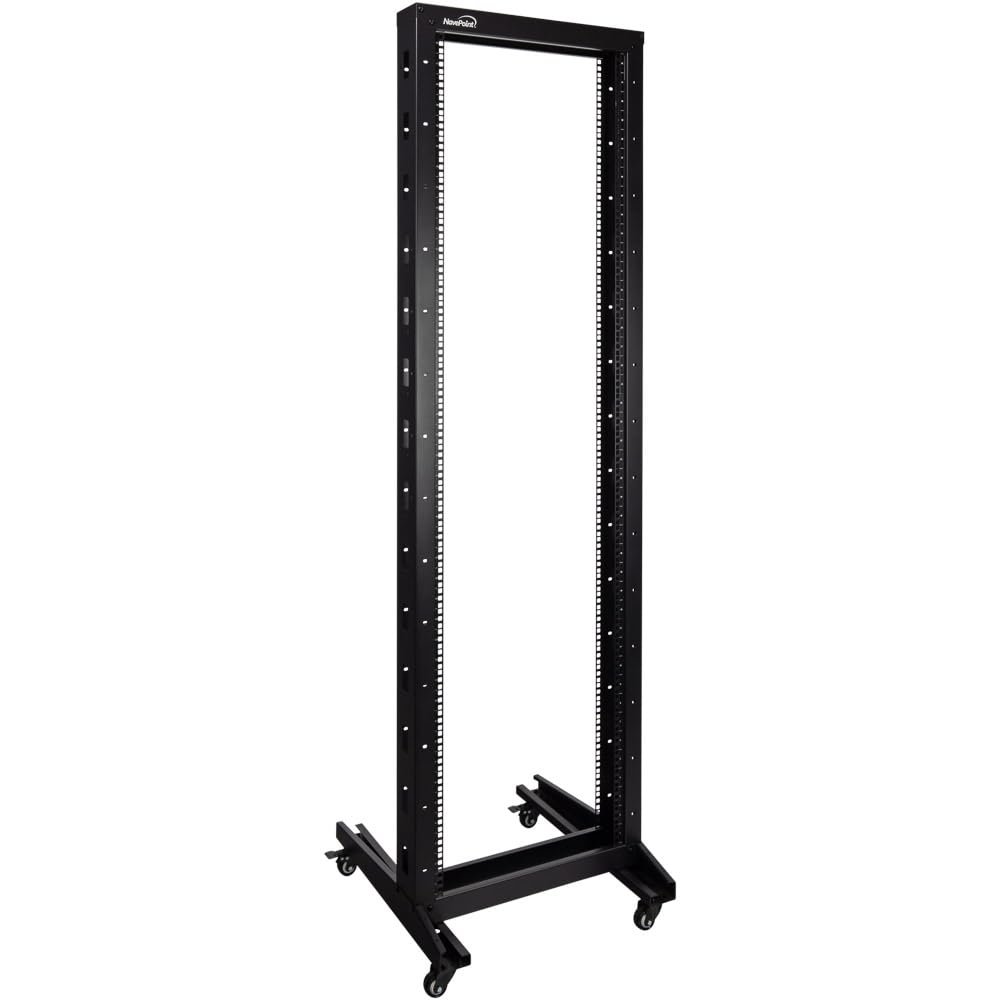
NavePoint 42U 2-Post open frame rack
See on AmazonModel comparison
| Model | Price | Rating | Material | Weight capacity | Best for | |
|---|---|---|---|---|---|---|
| | StarTech RACK-24U-20-WALL-OA open frame rack | $317.02 as of 10/31 See on Amazon | ★ 4.7 (400+ ratings) | Cold rolled steel | 200 lb | Network closet owners with shallow switches and patch panels get 24U of wall-mounted height without floor space. |
| | Tripp Lite SR2POST | $271.31 as of 10/31 See on Amazon | ★ 4.5 (150+ ratings) | Aluminum | 800 lb | Network closet or IDF builders with floor space get 45U of numbered positions, toolless PDU mounting and bolt-down provisions. |
| | NavePoint 42U 2-Post open frame rack | $285.99 as of 10/31 See on Amazon | ★ 4.6 (200+ ratings) | Alloy steel | 330 lb | Network-only builds needing full-height capacity for light gear, bolted down, and nothing deeper or heavier than that. |
 | StarTech 2POSTRACK42 | $252.99 as of 10/31 See on Amazon | ★ 4.6 (60+ ratings) | Alloy steel | not stated | Tight-room installs of switches and patch panels get a tall 42U dual-post frame on four swiveling casters. |
 | StarTech RK8OD | $57.36 as of 10/31 See on Amazon | ★ 4.7 (1,300+ ratings) | Alloy steel | 110.2 lb | Home office users who cannot drill into a wall get an 8U tabletop frame with marked U heights and 110.2 lb of capacity. |
What a 2 post rack actually supports and what it cannot
A two-post frame gives you one mounting plane. Equipment bolts to the front face of the posts by its ears and the chassis cantilevers rearward, hanging in the air behind the frame. That is the whole design, and it defines the job.
It is built for patch panels, switches, routers, media converters, small firewalls, AV and broadcast gear, and telecom distribution frames. These are shallow, front-heavy devices that get patched often, and having the sides and back wide open makes that patching easy.
It is not built for deep or heavy rackmount servers, storage arrays, multi-U UPS units, or anything that needs rear support or sliding rails. The ears exist to secure a device, not to carry its weight over a long lever arm. A deep chassis mounted only at the front puts a bending load on the ears and on the posts, and the further the weight sits from the mounting plane, the worse that load gets.
The practical check is to list your deepest and heaviest device first. If everything mounts from the front and nothing needs rear support, two posts work. If one item fails that check, the frame is the wrong frame.
Two-post racks are not weak. Current 45U models are rated in the 750 to 1,000 lb class. The limit is how the load is carried, not how much the frame can hold.
How two-post racks handle weight and tipping
Because equipment sits forward of the posts, the frame's center of gravity moves forward as you load it. A tall, lightly loaded two-post rack is stable. A tall rack with heavy gear high up and nothing anchoring it is not.
Anchoring is the fix, and every manufacturer's load rating assumes it. Bolting to a concrete slab is the default. Through a raised floor, the anchors go into the slab below. Into a wood subfloor, use hardware rated for wood. Where drilling is not allowed, ballast at the base plus bracing to the wall or ceiling does the same job.
Mount heavy items as low as the cabling allows. A rack UPS or a heavy switch at the bottom lowers the center of gravity; the same item at eye level raises it.
The tipping scenario worth planning for is a device or a drawer pulled out on a shelf or a slide, which moves weight further forward still. It matters when the frame is tall, a heavy item sits high up and nothing is anchored. It is prevented by anchoring first, loading low, and keeping sliding drawers out of the upper U of an unanchored frame.
Front-mount versus center-mount two-post racks
Front-mount is the standard configuration. The equipment ears bolt to the front face of the posts and the chassis cantilevers rearward. It suits shallow gear and anything you patch from the front.
Center-mount, also called mid-mount, positions the equipment so its center of gravity sits over the posts, usually through conversion brackets or mid-mount rails. The load is balanced instead of cantilevered.
Center mounting buys you less bending load on the ears, a more stable frame, and better access to rear connectors on long devices. It costs extra hardware and more planning, and the posts can interfere with rail travel on some chassis, so check clearance before committing.
The decision follows the gear. Shallow, front-patched equipment goes front-mount. Long or rear-cabled equipment that still has to live on two posts goes center-mount. Anything that needs full front-to-rear support is not a two-post job at all.
Choosing rack depth and rail spacing on a two-post frame
On a two-post rack, depth is not usable equipment depth. It is the footprint of the base and the depth of the uprights, meaning the space the frame occupies, not a tunnel your gear sits inside. Equipment still cantilevers forward from a single plane.
What depth does buy you is a bigger base footprint, which means more stability and more resistance to tipping, plus room behind the posts for rear cabling, a vertical PDU or a cable manager, and clearance from the wall. Size it for stability and rear access, not for enclosing gear.
Rail spacing works differently. The 19-inch figure is the front panel width including the ears. The clear opening between the rails is narrower, and the hole spacing follows the fixed EIA pattern. Check the clear opening against the widest chassis you plan to mount, and leave rear room for cable bend radius and a vertical manager if you are running structured cabling.
Leave headroom in U count for growth. A network closet fills up faster than expected once patch panels, cable managers and a PDU are counted.
Two-post racks for telecom and relay racks
Relay rack and telco rack are the traditional names for the two-post open frame. The modern 19-inch two-post rack is the same idea, standardized.
Hole pattern and threading are what actually differ between frames, and they decide what bolts straight in.
- Square holes take cage nuts in 10-32, 12-24 or M6. They are the most flexible, because you choose the thread by the nut you fit.
- Round threaded holes, also called tapped holes, take the screw directly. Common threads are 10-32, 12-24 and M6, and they are not interchangeable.
- Round unthreaded holes take clip nuts.
Telecom and network gear is commonly built around 12-24 tapped frames, while some server and AV equipment uses 10-32 and some European gear uses M6. The safe buy for a mixed closet is a frame whose hole type matches the majority of your gear, or square holes plus the right cage nuts.
A 23-inch variant exists for traditional telephony and DSX panels, and it is a different standard from 19-inch. Most network buyers want 19-inch, but a telecom closet refreshing old distribution frames should confirm before ordering.
Where a two-post frame stops working for your gear
- Any rackmount server or storage chassis that needs rear support or sliding rails.
- Any device deep enough that front-only mounting leaves it unsupported at the back.
- Rear-accessible cabling on deep equipment, because you cannot reach the back of a cantilevered chassis cleanly.
- A rack UPS or other heavy item that needs four-point support.
- A total load or a growth plan that will outgrow a single mounting plane.
When one of those applies, buy by characteristic instead. A four-post open frame gives front-to-rear support and adjustable depth. An enclosed cabinet adds security, dust and noise control, and a locked door. A wall-mount frame suits a light load where floor space is the constraint.
If a server might arrive later, either buy four-post now or plan for center-mount conversion hardware. Weigh the cost of that hardware against simply buying the four-post frame, because conversion hardware is a stopgap, not a substitute for rear support.
Our picks by budget
The StarTech RK8OD is the budget pick because it delivers the two-post format at its smallest and simplest: 8U of marked 19-inch positions that sit on a desk or shelf, with no anchoring and no assembly of a floor frame.
The Tripp Lite SR2POST is the mid-range pick because it turns the same idea into a full closet backbone: 45U of numbered positions, an 800 lb rating, toolless mounting for PDUs and cable managers, bolt-down provisions and a five-year warranty.
The StarTech RACK-24U-20-WALL-OA is the premium pick because it buys stability rather than size: a wall-mounted 24U frame with an adjustable 12 to 20 inch mounting depth, 0.079 inch (2.0 mm) steel rails and a five-year warranty, in a footprint that never touches the floor.
Budget
Mid-range
High-end
Which 2-post rack fits your install
The space-constrained install
No floor footprint to spare, a wall with 12- or 16-inch studs, and shallow-to-mid gear that you want out of the way. The wall frame fixes the rack in place and keeps the open front access.
The network closet or IDF build
Full height, structured cabling, a vertical PDU and room to grow, with floor space available and anchors you can drill. The 45U frame gives you numbered positions and toolless mounting for the accessories.
The mixed-hole closet
You have both tapped and cage-nut equipment and do not want to re-kit half of it. One side of this 42U frame is threaded and the other takes square cage nuts.
The square-hole steel buyer
You prefer universal square holes, a heavy-gauge steel frame and casters in the box, and a two-year warranty is fine for your install.
The bench or small-closet starter
A switch, a patch panel, a router and maybe some AV gear, limited space, and no wish to bolt anything down. The 8U tabletop frame gives you a real mounting plane on a desk or shelf.
Our verdict on the best 2-post racks
Two-post racks are the right, economical and easy-to-access choice for front-mounted network and AV gear, and the ranking reflects that: a compact desktop frame for small setups, a full-height floor frame as the default closet choice, and a wall frame where floor space is the constraint. The rule that overrides the ranking is simple. One rackmount server or one rack UPS on your list, and you should be shopping four-post instead.
Detailed model analysis
StarTech RACK-24U-20-WALL-OA open frame rack
The StarTech RACK-24U-20-WALL-OA gives you 24U of rack space without using any floor. It bolts to the wall, so a small data closet or office corner stays open.
Mounting depth adjusts from 12 to 20 in, so you can fit shallow switches and patch panels. At the 20 in setting there is room behind the gear for shelves and cable management.
It is made of SPCC cold-rolled steel and weighs 42 pounds. The frame measures 20 in deep and 19.8 in wide. It ships flat packed, so you assemble it yourself.
The open frame gives access to all sides of your gear and lets air move around it. It has no doors or side panels.
The main limit is load. The rack holds 200 lbs (90 kg) at most, which suits switches, patch panels and PDUs but not a stack of heavy servers. Depth stops at 20 in, so deeper chassis do not fit.
It includes M6 square cage nuts, M6 screws and a 5-year warranty. It suits a network closet or small office that wants 24U of height without giving up floor space.
- Brand: StarTech
- Rack height: 24U
- Weight capacity: 200 lb
- Mounting depth: 12 to 20 in adjustable
- Material: Cold rolled steel
- Weight: 42 lb
Tripp Lite SR2POST
The Tripp Lite SR2POST is the tallest rack we rank at 45U, with the highest load rating at 800 lb. It suits you if you are building a network closet with floor space.
It is made of heavy-duty aluminum and weighs about 29 lb (13.15 kg). Bolt-down provisions let you fix it to the floor.
Next to the StarTech RACK-24U-20-WALL-OA, it offers 45U instead of 24U and far more capacity.
Mounting holes are round and threaded 12-24, with numbered positions that help you track each device. It includes 28 12-24 screws and washers.
Vertical PDUs and cable managers mount without tools, and cable management hooks are included. The design is self-squaring. The PDUs and cable managers are not included.
It is an open 2-post frame with no doors or side panels, and it stands on the floor, which takes space a wall-mounted rack saves. A 5-year repair or replacement warranty backs it.
- Brand: Tripp Lite
- Rack size: 45U
- Frame type: 2-post open frame
- Weight capacity: 800 lb
- Mounting holes: 12-24 threaded, numbered
- Material: Aluminum
NavePoint 42U 2-Post open frame rack
The NavePoint 42U 2-Post open frame rack gives you 42U of height. You can bolt it to the floor or roll it on the included casters. The design is self-squaring and has bolt-down provisions.
The frame is alloy steel with a black powder-coated finish and square-punched cage nut style holes. It ships flat packed with the assembly hardware, so you build it yourself.
The main limit is weight. The 330 lb limit applies to a stationary load. That is below the 800 lb of the Tripp Lite SR2POST and the 663 lb of the StarTech 2POSTRACK42, which also has 42U.
It is an open frame with no enclosure, doors or side panels. You get access to cables and equipment, and air can move around the gear.
It suits you if you are building a network-only setup with light gear that needs full height, bolted down or on casters.
- Brand: NavePoint
- Rack height: 42U
- Weight capacity: 330 lb
- Dimensions: 23.75 in deep, 23.5 in wide and 81.75 in high
- Frame type: 2-post open frame
- Material: Alloy steel
StarTech 2POSTRACK42
The StarTech 2POSTRACK42 is a 42U rack on four swiveling casters, so you can roll it where the gear needs to go. It stands 81.9 in high including the wheels.
The frame is heavy-gauge alloy steel and weighs about 52 lb (23.59 kg). The kit includes two vertical rails, two horizontal rails and two bottom supporting beams. Steel was chosen over aluminum for a stable base.
Universal square holes run along the frame, and ANSI/EIA RS-310-D compliant gear mounts without extra hardware. It lists EIA/ECA-310, IEC 60297 and DIN 41494 compliance.
The open-depth, two-post design leaves room for longer equipment and gives easy front and rear access, even in narrow home or office spaces.
The rating applies to stationary loading only, so it is not for moving the rack loaded. The warranty is 2 years, shorter than the 5 years on the StarTech RACK-24U-20-WALL-OA and the Tripp Lite SR2POST.
It suits you if you need a tall rack for switches and patch panels in a tight room and want to roll it to the gear. Free lifetime 24/5 multilingual technical assistance comes with it.
- Brand: StarTech
- Rack space: 42U
- Rack width: 19 in
- Total height: 81.9 in (207.9 cm)
- Weight: 52.0 lb (23.59 kg)
- Material: Alloy steel
StarTech RK8OD
The StarTech RK8OD is an 8U two-post rack that sits on a desk, table or floor, so you do not need to drill into a wall. It is the only tabletop model we rank.
It weighs about 4.8 lb (2.16 kg), and rack unit heights are marked on the frame. Equipment mounts on the 19 in posts, and the frame meets EIA/ECA-310-E.
Front and rear access stay open, which helps when you plug and unplug often. M5 cage nuts and screws come in the box, and it ships as a compact flat pack.
It holds 110.2 lb (50 kg), the lowest rating of the five racks we rank. That covers light networking, AV and media gear, not a heavy stack.
The limit is size: 8U of space. Next to the Tripp Lite SR2POST at 45U or the StarTech 2POSTRACK42 at 42U, it is for a handful of devices.
It carries a lifetime warranty and free lifetime 24/5 multilingual technical assistance. It suits you if you work from a home office or small space where you cannot drill into a wall.
- Brand: StarTech
- Rack size: 8U
- Weight capacity: 110.2 lb
- Rack type: 2-post open frame
- Equipment width: 19 in
- Material: Alloy steel
Frequently asked questions
Can a two-post rack hold a switch and a patch panel without sagging?
Yes, as long as both mount from their front ears and the frame is anchored. A 1U switch and a 1U patch panel are light and shallow, which is the load a two-post frame is designed around. Keep the heaviest item low and check the frame's rating against the total.
What does a two-post rack's depth figure actually measure?
It measures how much floor or wall space the frame occupies, not how much chassis it can hold. Equipment still hangs forward from the front mounting plane, so a 20-inch frame does not give you 20 inches of supported chassis depth. Size depth for stability and rear cable clearance.
Do 2-post racks come with the screws I need?
It depends on the frame. Some ship with a set of screws and washers in one thread size, some ship with cage nuts and screws, and some ship with assembly hardware only. Check the thread your gear uses, 10-32, 12-24 or M6, and buy matching fasteners if the box does not cover it.
Can I put a two-post rack on casters?
Only if the model is built for it, and expect a lower rating than a bolted frame. Casters reduce stability and capacity, so a rolling frame should carry lighter gear and stay on a level floor. A bolted or wall-mounted frame is the safer choice for a tall, loaded rack.
Is a two-post rack good for a home lab?
Yes when the lab is switches, patch panels, routers and shallow gear. The moment a rackmount server or a rack UPS joins the list, go four-post, because those devices need support at the back that two posts cannot give.
What accessories should I plan for with a two-post rack?
Cage nuts and screws that match the hole type, blanking panels for empty U, a PDU sized to the rack, horizontal and vertical cable managers, and a shelf if you are mounting non-rack gear. Add them to the U budget before you pick the height.